
Executive Summary
This article documents the evolution of an ICT-based trading strategy from a mechanical 70% win-rate model to a liquidity-first framework achieving a 91.2% win rate across 148 manually backtested trades. The key breakthrough was shifting from rigid fair value gap entries to a three-step process: liquidity sweep, structural confirmation (MSS/BOS/CSD), and opposing liquidity targeting. Average risk-reward improved from 1.5R to 1.84R, with trades completing 50–70% faster. Every rule in this framework exists because something failed without it.
Introduction: Why This Strategy Exists
For several months, my trading was built around a simple, mechanical ICT model. From December 2024 until mid-2025, the approach worked well. The logic was straightforward:
- Identify a higher-timeframe fair value gap
- Wait for price to trade into it
- Look for an inversion on a lower timeframe
- Target opposing liquidity
The model was easy to execute, consistent, and delivered roughly a 70% win rate with a fixed 1.5R reward structure.
However, as market conditions began to change — especially during strong trends and abnormal directional moves — the limitations of this mechanical approach became obvious.
The Core Problem With My Previous Strategy
The issue was not entries. The issue was follow-through.
I started noticing a recurring pattern in my losing trades: price would enter the fair value gap, form an inversion on the lower timeframe, and instead of delivering toward the target, it would immediately run into stop loss.
When I reviewed my winning and losing trades side by side, the difference was clear. In the losing trades, I was entering without waiting for the market to confirm intent.
I realised that an inversion alone does not guarantee continuation. The market still needs to show a shift in control. Specifically, I was missing three critical confirmations:
- Market Structure Shift (MSS) — a decisive break of a prior swing point
- Break of Structure (BOS) — continuation confirmation within trend
- Change in State of Delivery (CSD) — impulsive momentum shift
These were not optional confirmations. They were structural requirements.
The First Major Change: Structure Before Entry
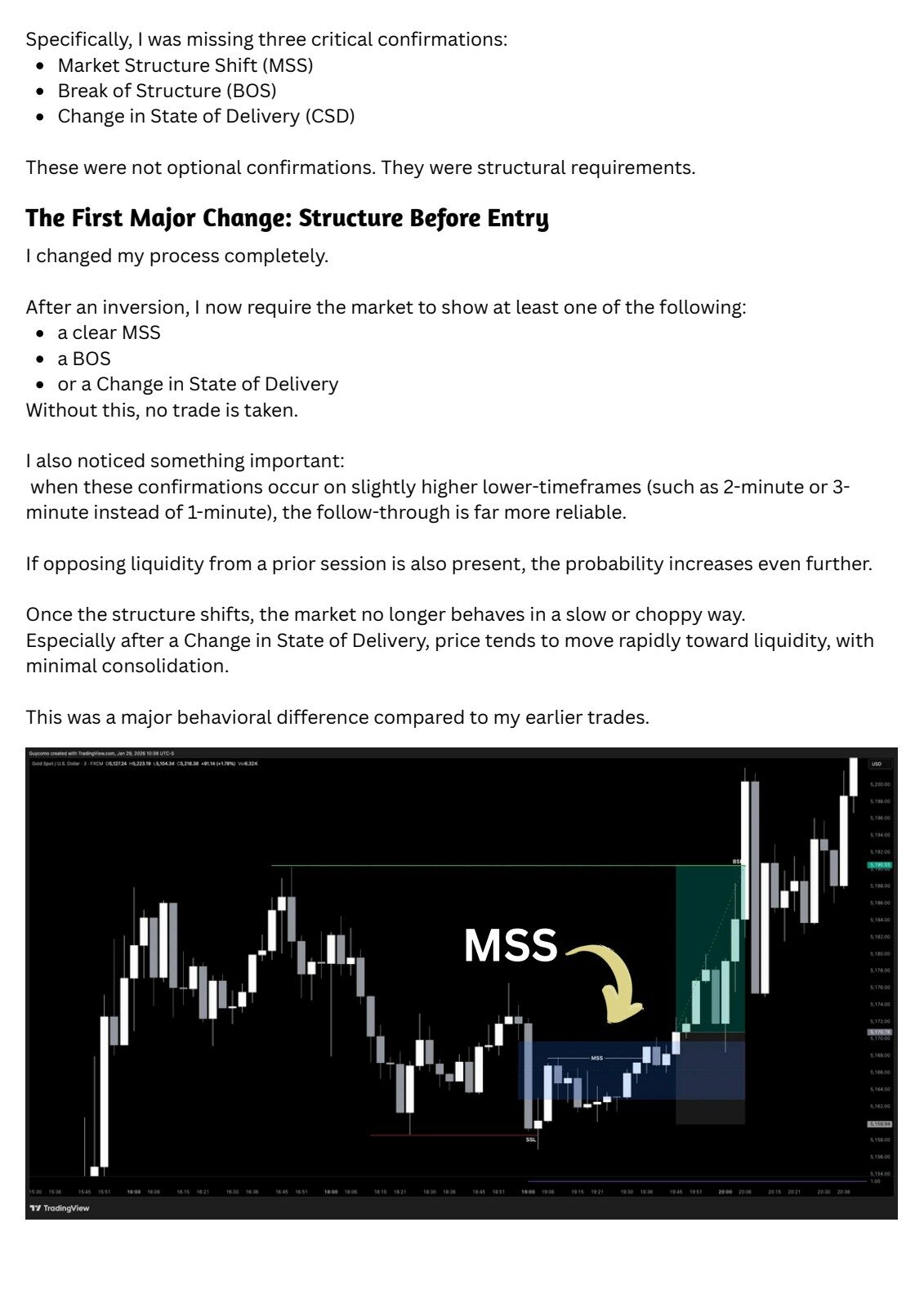
I changed my process completely. After an inversion, I now require the market to show at least one of the following:
- A clear MSS
- A BOS
- Or a Change in State of Delivery
Without this, no trade is taken.
I also noticed something important: when these confirmations occur on slightly higher lower-timeframes (such as 2-minute or 3-minute instead of 1-minute), the follow-through is far more reliable.
If opposing liquidity from a prior session is also present, the probability increases even further. Once the structure shifts, the market no longer behaves in a slow or choppy way. Especially after a Change in State of Delivery, price tends to move rapidly toward liquidity, with minimal consolidation.
The Second Major Change: Liquidity Over Mechanical FVGs
The second realization was even more important. I stopped requiring a higher-timeframe fair value gap altogether.
I observed price repeatedly disrespecting higher-timeframe FVGs — entering briefly or ignoring them completely. The model had become too mechanical and lacked a true liquidity narrative.
So instead of forcing price into a predefined zone, I shifted the focus to liquidity first. Now, my process begins at the session open: I wait for the market to take a high or a low — sometimes even a seemingly "random" one.
- If price sweeps liquidity and fails to show structure, I do nothing. No reversal is assumed.
- If a liquidity sweep is followed by a clear structural response (MSS, BOS, or CSD), the intent becomes obvious.
- Only when liquidity is taken, structure confirms direction, and opposing liquidity exists do I execute a trade.
The Results
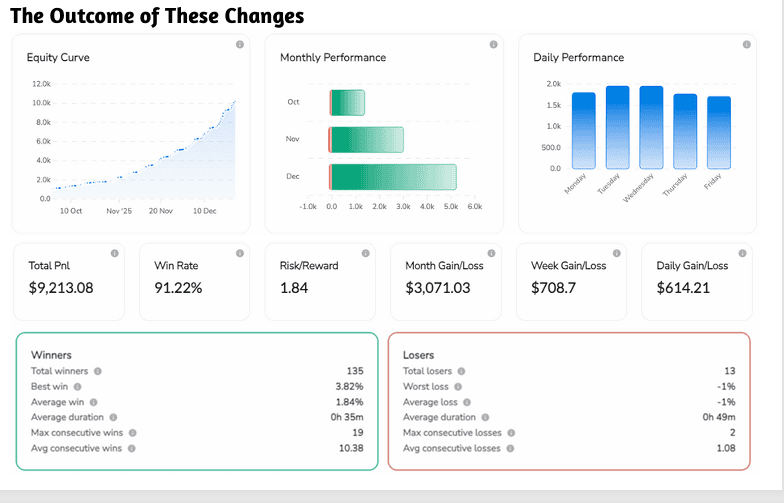
This shift from mechanical execution to liquidity + structure confirmation changed everything:
- Win rate increased from ~70% to 91.2%
- Average risk-reward improved from 1.5R to 1.84R
- Trades stopped consolidating unnecessarily
- Momentum became cleaner and more decisive
- Trade duration reduced by 50–70%
This strategy is backed by three months of manual backtesting, covering 148 trades, all replayed in FxReplay and fully documented with screenshots.
Strategy Overview: The Core Philosophy
This strategy is built around a simple idea: Liquidity first. Structure second. Execution last.
Instead of forcing trades around predefined higher-timeframe zones, the model waits for the market to reveal intent through liquidity sweeps and structural confirmation.
For a setup to even be considered, two conditions must exist:
- A clear liquidity sweep
- Opposite side liquidity that can realistically be targeted
The most reliable form of opposing liquidity comes from previous session highs or lows — not the current session, but liquidity that already exists and is visible to the market.
Core Components of the Strategy
1. Liquidity Sweep (Context Builder)
Every setup begins with liquidity. The market must take a high or low — sometimes even a seemingly random one. This sweep alone does not mean reversal or continuation.
- If liquidity is taken and nothing else follows, no trade is taken
- Liquidity only gives context
- Structure gives confirmation
2. Inversion of Fair Value Gap (IFVG)
After the liquidity sweep, the first technical clue is an inversion of a fair value gap on the lower timeframe. This inversion acts as an early signal that order flow may be shifting.
- This is not used as an entry trigger by itself
- It is only a precondition
- Clean IFVGs vs messy IFVGs must be distinguished through pattern recognition
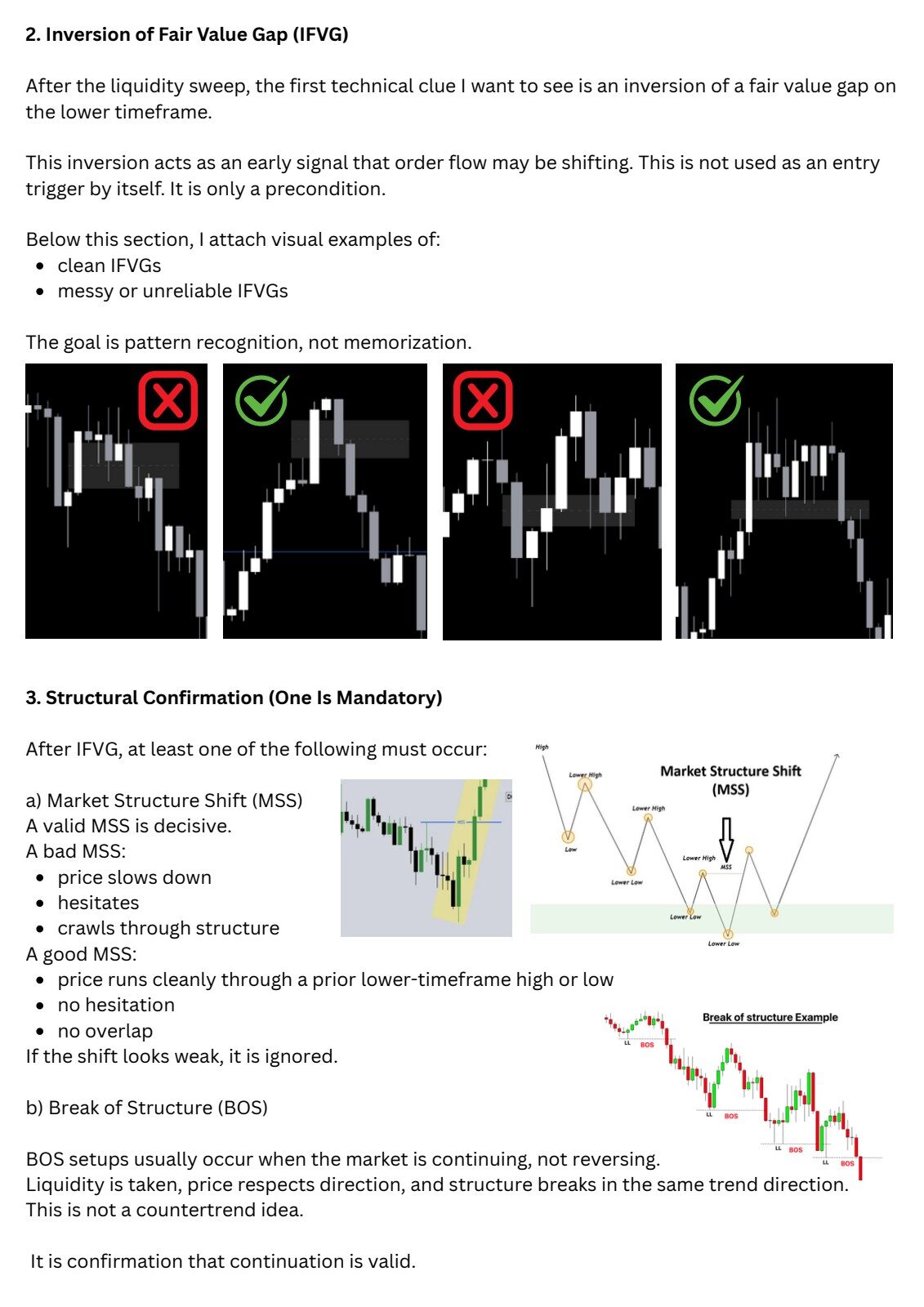
3. Structural Confirmation (One Is Mandatory)
After IFVG, at least one of the following must occur:
a) Market Structure Shift (MSS)
A valid MSS is decisive. A good MSS shows price running cleanly through a prior lower-timeframe high or low — no hesitation, no overlap. A bad MSS shows price slowing down, hesitating, and crawling through structure. If the shift looks weak, it is ignored.
b) Break of Structure (BOS)
BOS setups usually occur when the market is continuing, not reversing. Liquidity is taken, price respects direction, and structure breaks in the same trend direction. This is not a countertrend idea — it is confirmation that continuation is valid.
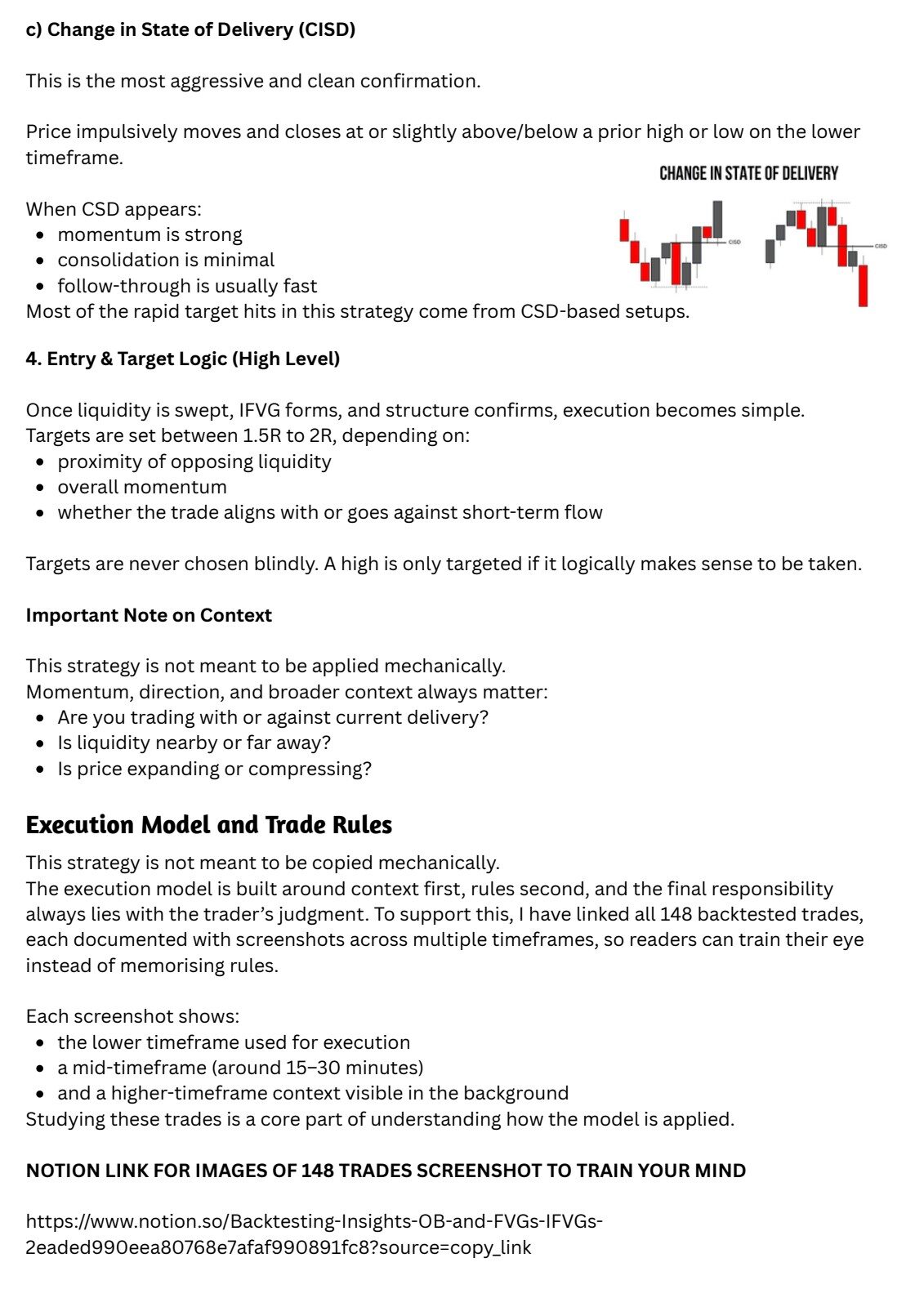
c) Change in State of Delivery (CISD)
This is the most aggressive and clean confirmation. Price impulsively moves and closes at or slightly above/below a prior high or low on the lower timeframe. When CSD appears:
- Momentum is strong
- Consolidation is minimal
- Follow-through is usually fast
Most of the rapid target hits in this strategy come from CSD-based setups.
4. Entry and Target Logic
Once liquidity is swept, IFVG forms, and structure confirms, execution becomes simple. Targets are set between 1.5R to 2R, depending on:
- Proximity of opposing liquidity
- Overall momentum
- Whether the trade aligns with or goes against short-term flow
Targets are never chosen blindly. A high is only targeted if it logically makes sense to be taken.
Execution Rules
Rule 1: Direction Comes First (Non-Negotiable)
Before thinking about entries, the higher-timeframe direction must be respected:
- In a strong bullish environment, deep sell-side liquidity is unlikely to be taken immediately
- Buy-side liquidity has a much higher probability of being targeted
- Expecting deep retracements during strong directional phases leads to poor trades
- Session context matters — liquidity formed and taken within the same session often targets opposing liquidity in a future session
Rule 2: Liquidity + Structure With Directional Bias
Liquidity sweeps are necessary, but they are filtered through directional logic:
- A liquidity sweep against strong higher-timeframe momentum is treated cautiously
- A liquidity sweep aligned with the broader flow is given more weight
- Structure confirmations (MSS, BOS, or CSD) are still mandatory but interpreted through this directional lens
Rule 3: Risk-Reward Philosophy (High Win Rate First)
This strategy prioritises high probability and consistency, not extreme reward multiples. Ideal trades offer 1.5R to 1.8R, occasionally extending toward 2R if conditions allow.
If a setup does not offer at least 1.5R:
- The stop loss is not moved
- The target is not extended
- Only the entry is adjusted
If price fills, it fills. If it doesn't, it doesn't. There will always be another session.
Rule 4: Target Selection (Speed Over Perfection)
Targets are never placed at exact highs or lows. Instead:
- Targets are placed just below highs or just above lows
- Wick extremes are avoided intentionally
This sacrifices a small portion of potential reward but dramatically reduces trade duration, unnecessary consolidation, and missed exits. In many cases, this reduces trade time by 50–70%, allowing trades to complete within 15–30 minutes.
Rule 5: Train the Eye, Not the Rules
The execution rules are intentionally minimal. The real edge comes from:
- Studying the 148 documented trades
- Understanding how structure behaves across timeframes
- Recognizing when NOT to trade
Backtesting Process and Self-Validation
Separate Development Data From Testing Data
Never develop a strategy on the same data you plan to test it on. For example, if you want to evaluate performance during October–December, that period becomes testing data — you do not touch it while building the strategy. Instead, go back to earlier months where the strategy stopped working. That is where development begins. This prevents hindsight bias and false confidence.
Pattern Discovery Before Rules
When the previous model stopped working, I did not immediately add rules. I replayed earlier data and simply observed:
- Where trades failed
- Where targets were missed
- Where momentum stalled
- Where liquidity was respected or ignored
Each observation eventually became a rule.
Build Rules Only From Repetition
No rule was added after seeing it once. The same sequence had to appear again and again — liquidity taken, IFVG present, MSS/BOS/CSD confirmed, price delivering efficiently toward opposing liquidity. Only after repeating this process dozens of times did the rules become fixed. This was done across roughly 150 replays, not a handful of trades.
Short Backtests Are Enough (If Done Properly)
If you trade lower timeframes, you do not need months of replay to test logic. Five to seven trading days are often enough to determine whether the logic is consistent, whether entries make sense, whether losses are controlled, and whether execution feels repeatable.
Replay Slowly — Train Patience
One mistake many traders make is replaying too fast. Backtesting should simulate real execution pressure. In FXReplay, I recommend candle formation speed set to fast, with each candle advancing every 5 seconds. This makes even a one-minute candle feel like it is forming live. It trains patience, discipline, and emotional control during drawdowns.
Track Psychology, Not Just Results
While replaying, pay attention to:
- Consecutive wins and consecutive losses
- Emotional reactions
- The urge to force trades
Backtesting is not only about numbers — it's about whether you can execute the same logic repeatedly without deviation. If psychology fails in replay, it will fail harder in live markets.
Study, Don't Memorize
The backtested trades are not meant to be copied. They are meant to train pattern recognition, understand structure behaviour, see when not to trade, and recognize high-quality vs low-quality setups. The goal is not to replay the data endlessly — the goal is to understand why decisions were made.
Key Takeaways
- Liquidity first, structure second, execution last — this sequence is non-negotiable
- An inversion alone is not enough — always wait for MSS, BOS, or CSD confirmation
- Higher-timeframe FVGs can be misleading — focus on where liquidity actually sits
- 91.2% win rate is achievable with disciplined, confirmation-based entries
- Speed matters — placing targets slightly inside highs/lows reduces trade time by 50–70%
- Backtesting is about training decisions, not proving profitability
- Psychology is part of the edge — track your emotional state during replay
- Consistency beats perfection — 1.5R to 1.8R with high win rate compounds faster than chasing 3R+ with low hit rate
- The market always shows intent — your job is to wait for it, not predict it
Conclusion
This strategy was not created to chase perfect entries or extreme targets. It was built to align liquidity, structure, and execution in a way that makes sense under real market conditions.
The shift away from mechanical rules and toward waiting for the market to show intent is what ultimately made the difference. Every rule in this framework exists because something failed without it. Nothing here was added for complexity — only for clarity.
This is not a plug-and-play system, and it is not meant to be followed blindly. The real value comes from studying the setups, understanding the structure, and building confidence through repetition.
If there is one takeaway from this strategy, it is simple: Let the market show its hand first — then respond. That mindset is what keeps execution consistent over time.
Disclaimer
This article is for educational and informational purposes only. It does not constitute financial advice, investment advice, or a recommendation to trade. Trading in financial markets involves substantial risk of loss and is not suitable for every investor. Past performance, including the backtesting results presented here, does not guarantee future results. Always do your own research and consult with a qualified financial advisor before making any trading or investment decisions. You are solely responsible for your own trading outcomes.